
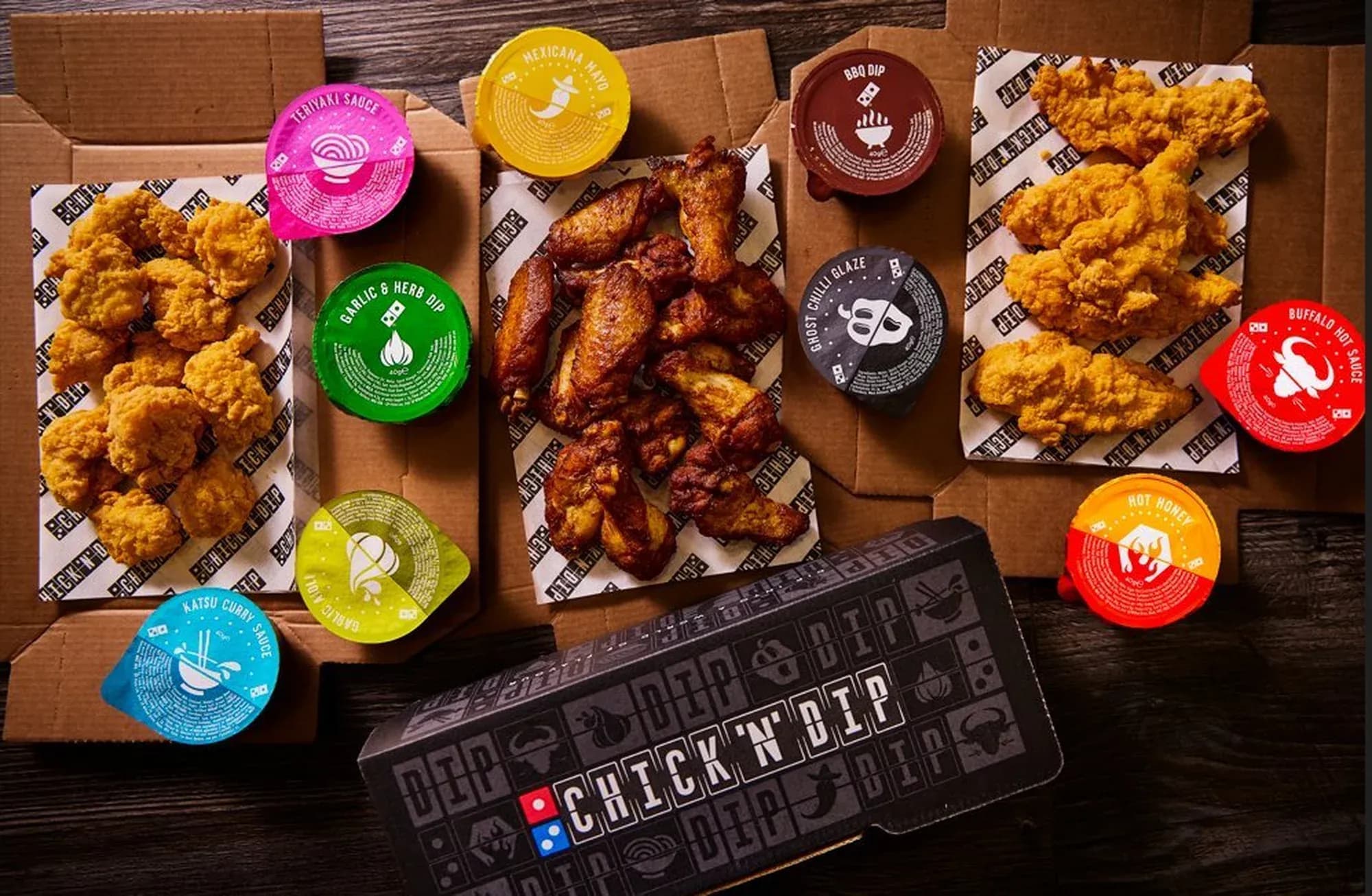
Why Is Domino’s Selling Chicken? Your Second Business May Already Be Inside Your First.
Domino’s used its existing kitchens and supply chain to expand in the chicken category. The CHICK ’N’ DIP case explores how companies might unlock a second growth opportunity from infrastructure they have already built. When does serving more demand through the same system create efficiency, and when does it add operational complexity?
External Case Review / Dış Vaka Analizi. This is an independent Sellf analysis based on public company disclosures. It is not a client engagement carried out by Sellf. The company reviewed is Domino’s Pizza Group plc, which operates in the UK and Ireland; it should not be confused with US-based Domino’s Pizza, Inc.
A pizza business selling chicken can look like a simple menu extension. For management, the more interesting possibility is this: can a system built to serve one kind of demand also serve another, adjacent need?
What makes CHICK ’N’ DIP relevant again today is not its September 2025 trial launch. It is Domino’s Pizza Group’s third-quarter update, published on 21 October 2026. The update adds a new data point for assessing the strategy. It does not reveal how profitable the chicken concept is on its own.
1. Situation: A new growth opportunity may sit inside the existing system
Domino’s already sold chicken products, as its corporate announcement of 8 September 2025 makes clear. The move with CHICK ’N’ DIP was to develop the category around a distinct identity and a more visible proposition.
For Sellf, the starting question is: what other demand could the system your company has already invested in building serve economically?
A kitchen, warehouse or delivery network is more than a cost attached to today’s product. It may contain capabilities that could meet another customer need. That potential alone, however, proves neither demand for the new category nor the ability to serve it profitably.
2. Approach: A new proposition, a shared operation
On 8 September 2025, CHICK ’N’ DIP entered a trial in 187 stores in northwest England and Northern Ireland. The company said it would use existing national supply-chain infrastructure and kitchens, with minimal additional capital investment.
Wider distribution followed. The company’s 6 February 2026 announcement set out a rollout across stores in the UK and Republic of Ireland, available from 9 February. Its product page dated 31 March 2026 also describes nationwide availability.
Sellf sees the potential advantage in testing a new proposition through existing production, sourcing, delivery and customer-access capabilities. This may reduce the entry investment compared with building each capability again. A new category still creates product-development, training, inventory, marketing and service demands. Low additional capital expenditure does not mean low total cost.
3. Results: The system is growing; the concept’s standalone economics remain unclear
The 21 October 2026 update reported growth of 3.5% in total system sales, 2.3% in like-for-like sales and 1.4% in like-for-like orders for the quarter ended 30 September. These are system-wide measures, not separate CHICK ’N’ DIP results.
Management named growth in both pizza and CHICK ’N’ DIP among the drivers of positive performance. That is a favourable management assessment of the concept. It is not a calculation showing how much of total growth came from chicken.
The reviewed disclosures do not establish standalone profitability, ROI or new-customer contribution for CHICK ’N’ DIP. They therefore do not support a claim of proven investment returns or sustainable net-profit growth from the concept. System sales should also not be confused with the company’s recognised revenue or net profit.
4. Sellf’s interpretation: Shared infrastructure must produce measurable incremental value
Opening existing infrastructure to a second source of demand can improve efficiency when usable capacity exists and the new demand can be served without weakening the core business. Production capacity during quieter hours, for example, might support a category that generates genuinely additional orders. This is a growth hypothesis for businesses to test, not a disclosed outcome for Domino’s.
The constraint often appears at peak times before it shows up in average utilisation. If a new product consumes oven time, preparation space or delivery capacity, service for existing orders may suffer. A kitchen that looks underused on average may already be full during its most valuable trading hours.
Cannibalisation needs its own measurement. If some chicken sales replace pizza or another product the customer would previously have bought, the new category’s entire revenue is not incremental growth. Being purchased together does not prove additional profit either: basket composition, discounts and service costs must be assessed together.
Sellf’s assessment starts with additional category sales and subtracts direct product, packaging, payment, promotional, additional labour and delivery costs. Then assess contribution lost from existing products and the value of alternative uses of capacity. This helps identify incremental contribution; it does not replace a net-profit or EBITDA calculation. ROI requires a defined investment amount and evaluation period as well.
5. Application: Five questions before entering a new category
Customer access — What evidence of this need exists within your current customer base? Does the proposition create a new purchasing occasion, increase the existing basket or move the same spending to another product? Measure each possibility separately.
Usable capacity — How much capacity actually exists in production, storage, staffing and delivery? Examine peak periods and bottlenecks alongside weekly averages. Record baseline service times for the core product.
Additional investment — Include training, software, inventory funding, launch costs and working capital alongside equipment. Using an existing system does not make these requirements disappear.
Incremental contribution — Track variable costs by order and customer group. Where possible, compare similar stores, regions or periods to separate additional contribution from displaced sales. Do not make total revenue growth the sole threshold for success.
Operational impact — Set acceptable limits for service times, errors, refunds, inventory waste and the core product’s contribution before the trial starts. Use those limits and repeat-purchase behaviour to decide whether to expand, adjust or stop.
CHICK ’N’ DIP does not tell us that every company should enter a second category. What deserves examination is the growth opportunity contained in existing capabilities. Sustainability depends less on the attention a proposition receives at launch than on the additional economic value it can repeatedly produce within the same operation.
Your second business may already be inside your first. Finding it takes a question that goes beyond “What else could we sell?” Ask: “What other demand could the system we have already invested in building serve, without weakening our core business and while producing measurable incremental value?”
Sources and scope
Domino’s Pizza Group — 8 September 2025: launch announcement
Domino’s — CHICK ’N’ DIP product page, 31 March 2026
Domino’s Pizza Group — Q3 trading update, 21 October 2026
Domino’s Pizza Group — national rollout announcement, 6 February 2026
Domino’s Pizza Group — corporate launch release, 8 September 2025
Cover image: Domino’s Pizza Group’s national rollout announcement. Company statements and Sellf’s interpretation are distinguished throughout. Sources checked: 26 October 2026.