
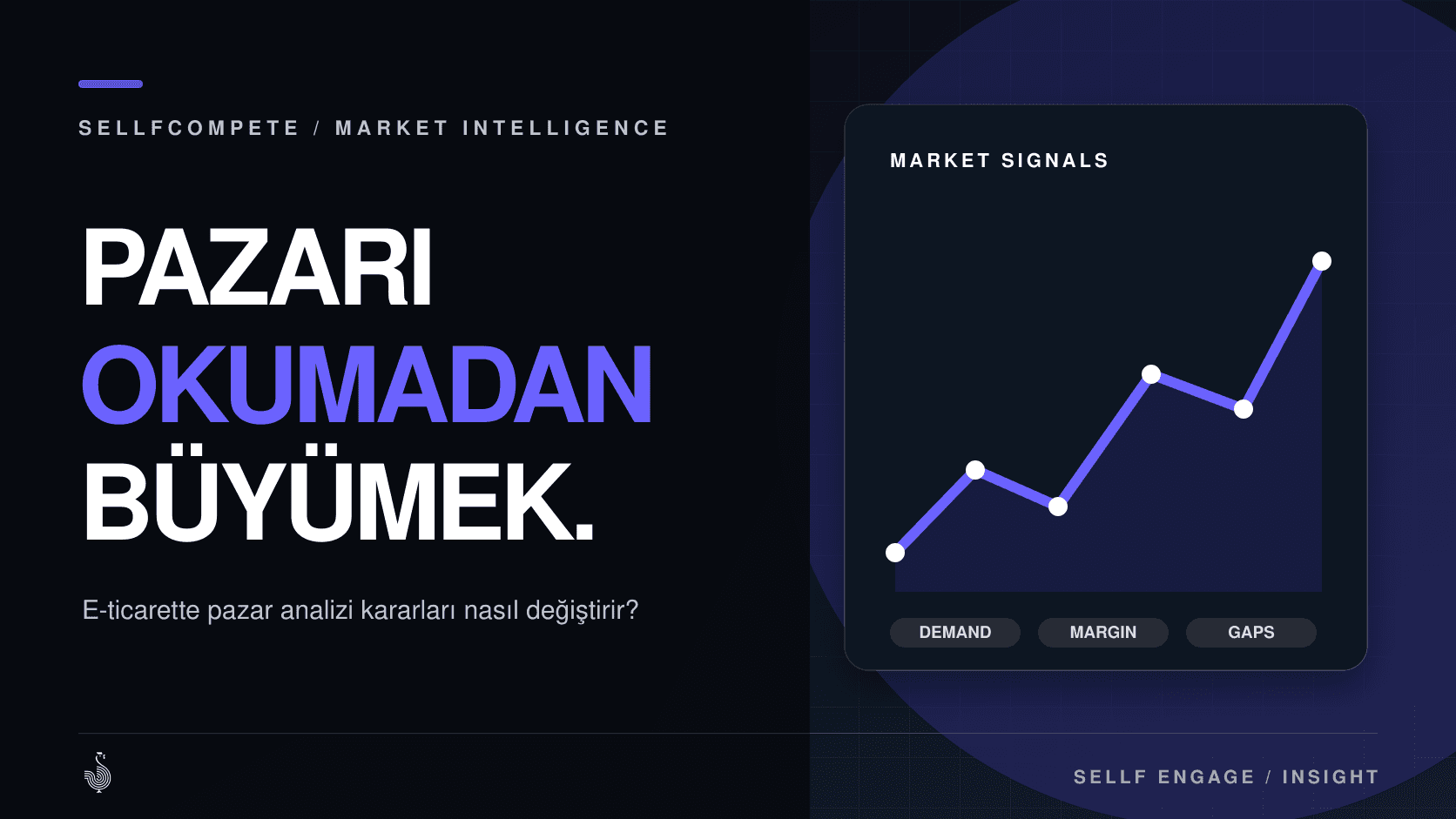
Ecommerce Market Analysis: The Decision Matters More Than the Data
Market analysis is not a list of competitors. It connects demand, margin, customer tension and growth gaps inside one decision system.
Market analysis is decision infrastructure, not a report
In ecommerce, market analysis is often reduced to one question: how big is the market? The real purpose is to make better choices about where to play, which customer to serve, what offer to build and where to direct growth investment.
A strong analysis removes three common illusions:
- Treating high search volume as proof of strong purchase intent.
- Reading competitor visibility as profitable, sustainable growth.
- Using category averages without testing them against your own pricing, margin and operating reality.
Why ecommerce market analysis matters
Traffic alone is not growth. Demand can exist without margin; a product can attract attention while fulfilment economics fail; a competitor can become visible without creating repeat purchase. Market analysis connects the opportunity outside the business with the capability inside it.
How to conduct market analysis
- Define the market boundary: category, use case, geography and price range.
- Combine demand signals: search trends, marketplace data, reviews, social conversation and sales data.
- Map customer tensions: study why people abandon a choice, not only what they say they want.
- Test the economics: do price, gross margin, acquisition cost, returns, logistics and repeat purchase work together?
- Map growth gaps: find the space between what competitors promise and what customers still cannot solve.
- Turn findings into scenarios: state what each signal changes in product, pricing, channel, message or operations.
Why Sellf puts market analysis first
A strategy built without reading the market is simply a more organised guess. Sellf connects customer research, commercial economics, channel signals and operational reality. The objective is not a thicker presentation; it is a decision map that reduces uncertainty.
How SellfCompete strengthens the process
SellfCompete brings competitor data, sector trends and market gaps into an AI-assisted analysis flow. Teams can move beyond “What are competitors doing?” to ask which signals are growing, where the market is saturated and where a defensible opportunity exists.
Example: entering a new ecommerce category
Before entering a category, a brand can use SellfCompete to examine competitor density, repeated claims, price clusters and visible market gaps. The output then shapes the offer, launch message, channel priority and testing budget. The value of the analysis lies in the decision it changes.
The final question should always be the same
Not “What does this data show?” but “Which decision will we make differently because of it?” If there is no answer, the analysis is not finished.