
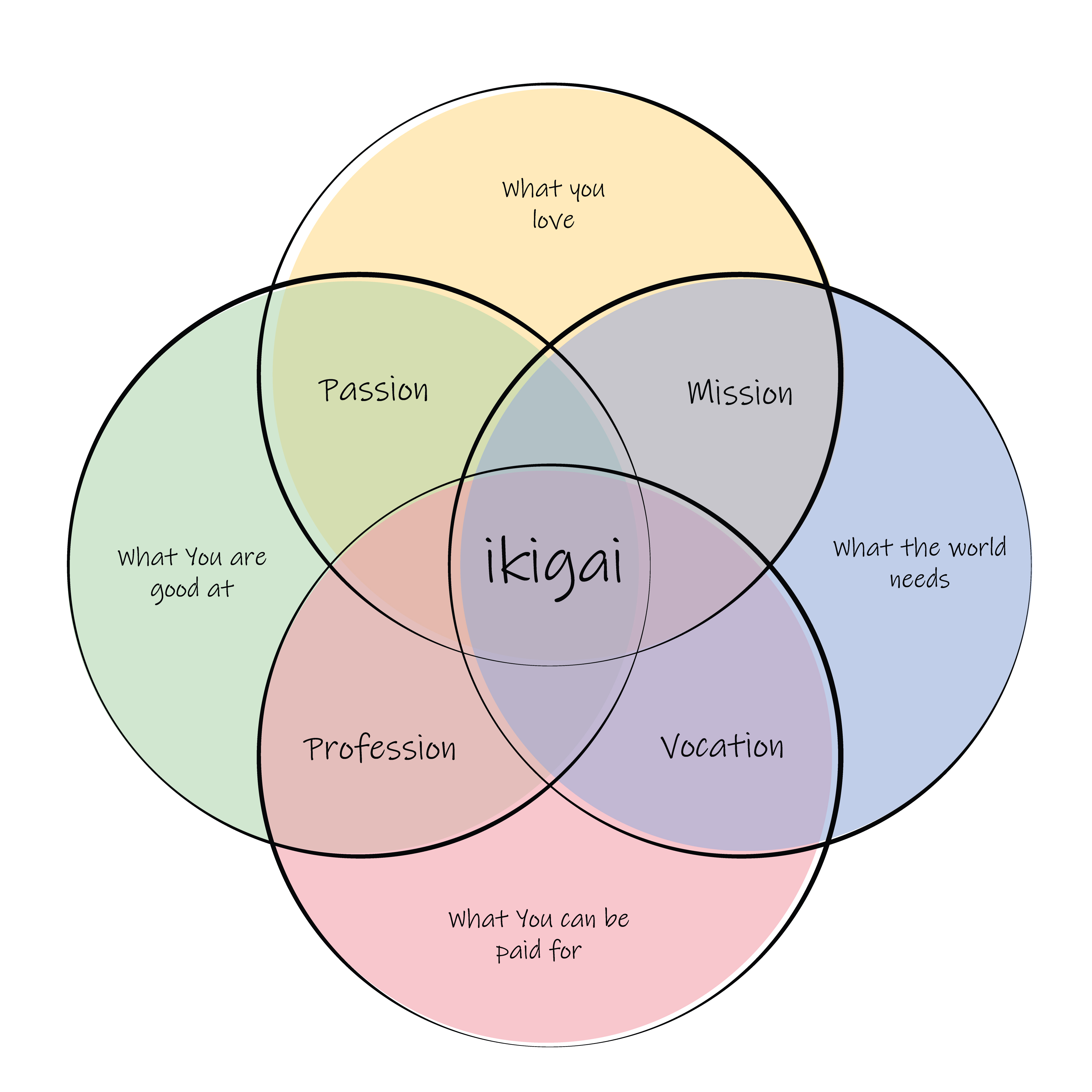
Whatever business you do, whatever kind of company you are, the element of success depends on two things: the Person and the System. The person is essential for performance; the system is essential for sustainability. The first part of this book—the development phase—is fundamentally about character development. For both corporate entities and real persons... Here, our baseline measurement and perspective, as mentioned in the introduction, is the philosophy of Ikigai. In other words, at this juncture, both brands and individuals must answer the following:
Who am I? What am I best at? What do I enjoy the most or want to progress in? What needs exist in society that I can fulfill?
This means that Ikigai essentially points to the perfect intersection of desire, skill, qualification, and need.
The two fundamental mistakes made here are as follows: individuals and companies usually forge ahead either by relying solely on the product without considering the need at all, or purely in line with their own desires. Companies that enter a market just because they see revenue potential, entrepreneurs who step into an industry simply because they saw a wealthy friend, or developers who plunge into an exploitative game project that nobody will ever play just because it happens to be their passion project... Seeing examples of success in these areas does not change the fact that this perspective is fundamentally flawed.
For human nature is wired to tell stories of the beautiful and to forget—or make others forget—the ugly. Compared to every successful venture or massive growth story, there are hundreds of times more examples of failure.
This, of course, does not mean you should remain inactive and avoid taking risks. It is simply about accurately reading both yourself and what lies beyond your front door. Let’s move forward by looking at some basic examples of this:
1. Paul Davison & Rohan Seth — Clubhouse (The Crisis-Era Illusion)
At the beginning of 2021, Clubhouse was an invite-only digital elite club that everyone was dying to join. The entrepreneurs assumed that people's need for "audio-only communication" was a permanent behavioral shift.
- The Big Mistake: The entrepreneurs failed to read that the main trigger behind the platform's explosion was pandemic isolation and pure boredom. As life returned to normal, people no longer had hours to spend listening to idle chatter in audio rooms.
- Underestimating the Competition: Before Clubhouse could even figure out what it was, Twitter (Spaces), Spotify (Greenroom), and Discord—all of which already possessed massive user bases—integrated their own audio rooms. Clubhouse failed to account for its competitors' distribution power and evaporated as a standalone app.
2. The AI Wrapper / Micro-SaaS Craze and Mass Collapses (2023 - 2025)
With the explosion of ChatGPT, hundreds of entrepreneurs emerged on platforms like Twitter (X) and Indie Hackers, claiming to make $30,000 to $50,000 in monthly revenue just by dressing up a simple AI API (AI Wrapper). Thousands of developers and entrepreneurs immediately copied similar products and dived into the market the very next day, simply because they saw "those high-earning friends/influencers." They never asked, "Who am I, and what kind of sustainable system do I have in this market?"
- The Result: Because they focused solely on revenue potential and failed to solve a deep market need, 95% of these copycat ventures vanished overnight every time OpenAI released a new update (for instance, when they added PDF reading or visual analysis to the free version).
3. Corporate NFT and "Metaverse Land" Mania (2021 - 2023)
This was a period when major firms and individual investors poured millions of dollars into digital images and pixel blocks (land) on platforms like Decentraland, none of which had any logical foundation. Adidas, Nike, major banks, and thousands of individual entrepreneurs funneled billions of dollars in funding, saying, "Everyone is making crazy money here, we mustn't fall behind," without ever questioning whether society had even the slightest need for it.
- The Result: Today, 99% of those "lands" and NFTs are worth zero. There was neither a sustainable system nor a genuine human need behind them.
4. Fntastic Studio — "The Day Before" Fiasco (2023)
The gaming world's biggest and most exemplary scandal in recent years. A game studio named Fntastic announced they were making a massive MMO survival game called "The Day Before." They generated incredible hype for years. The studio utilized "volunteer" developers and designers (working part-time and for free or very little pay) from all over the world to develop the game. A truly exploitative structure was established. The company management completely forgot that the market actually needed real game mechanics and stability; instead, they relied solely on the "dream product" in their own heads and its marketing.
- The Result: The game was released in December 2023; it was completely empty inside, nothing more than a broken pile of assets containing none of the promises. Players expressed pure hatred. Just 4 days after the release, the studio officially declared bankruptcy and shut down.
5. Mark Zuckerberg — Reality Labs / Horizon Worlds (2021 - 2024)
Mark Zuckerberg's Metaverse gamble, where he went so far as to rebrand the company name to "Meta," moving forward strictly in line with his own vision and desire... In the corporate world, this is the pinnacle of the mistake of "completely ignoring social needs, moving forward purely on one's own desires, and over-relying on the product." Zuckerberg believed that people would want to hold business meetings in virtual worlds using primitive avatars that didn't even have legs (his own desire). The industry and consumers simply did not have such a need yet.
- The Result: Meta announced a loss of over $40 billion in this department (Reality Labs) alone. When the company's stock crashed, he was forced to step back under investor pressure and pivot the course toward artificial intelligence.
Today on YouTube or in business media, only the "beautiful stories" are told, like Eric Barone, who made Stardew Valley all by himself and earned millions of dollars. But nobody ever mentions the hundreds of thousands of developers who leave their youth, money, and mental health at that desk by writing code night and day at home or in the office, producing games or software that nobody will ever look at and that touch no market need. Because the system quietly buries those who sink.
Perhaps this paints too pessimistic a picture for us. Facing the dark side of the world is often harder and less likely than looking at its bright side. However, the goal here is precisely to counteract this. No one can ever be successful using a single methodology or method. In fact, by the time they start to be, the system adapts and changes itself anyway. Still, the right systematic approach and the right mindset serve to minimize risk.
This is exactly what Ikigai provides us here. Understanding the road and making the right preparations before we even set out means minimizing our margin of error.
To summarize this chapter, right before setting out on a path—before launching a venture, bringing an idea to life, creating an expansion for your company, or entering a new market—every firm and individual must answer these four questions:
- Who am I? What do I do, what is my element of trust, how am I perceived, and what are my weaknesses/strengths?
- What am I good at? As a company or an individual, in which areas would I have a competitive advantage?
- What is it that I enjoy the most, want to do, or aim for?
- Does what I want to do (operation, expansion, product, idea) have an equivalent in society? Is this need, or the demand I anticipate, real?